
Short answer
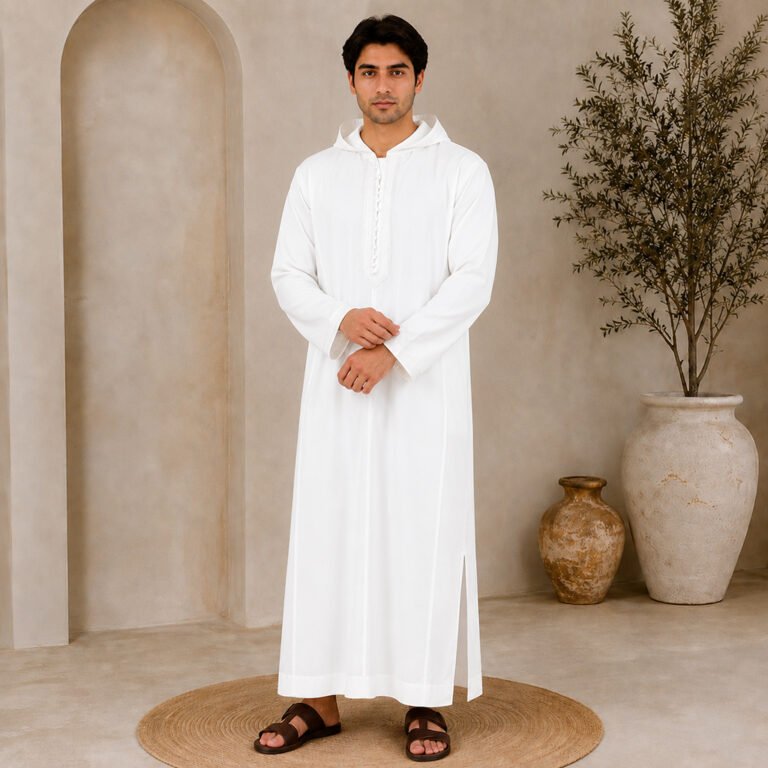
A Moroccan djellaba is a long, loose robe with a pointed hood called a qob. The hood is what defines it: remove the qob and the garment is no longer a djellaba. It is worn by men and women across Morocco for everyday life, prayer, Eid and weddings, in cotton or linen for summer and wool or heavier blends for winter. The finer ones are edged with hand-stitched braid called sfifa and fastened with knotted button loops called aqad. Men Thobes UK cuts hooded Moroccan djellabas to order at £38 each, sizes S to 8XL, with any three for £85 and free UK delivery.
Most guides to the djellaba are written from Morocco. They tell you about the souks of Marrakech, the High Atlas, the Sahara. That is the right history, but it leaves a question unanswered for the person actually reading in Britain: what is this garment, how is it different from a thobe, and does it make any sense to wear one in Bradford in February?
This guide answers the general question properly, then answers the British one too. The short version of the second answer is that a hooded robe designed for Saharan wind turns out to work remarkably well in a country that rains a third of the year.
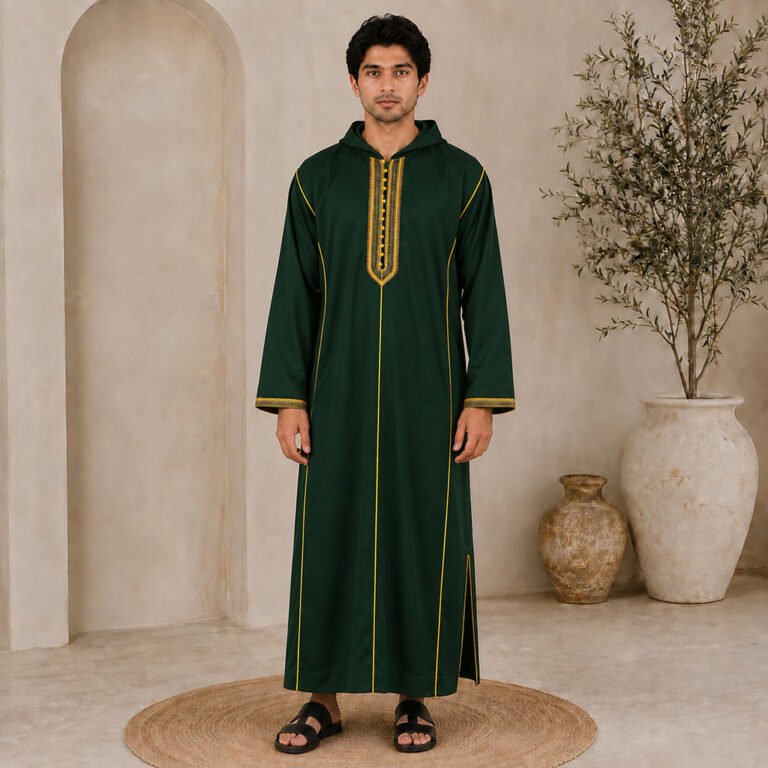
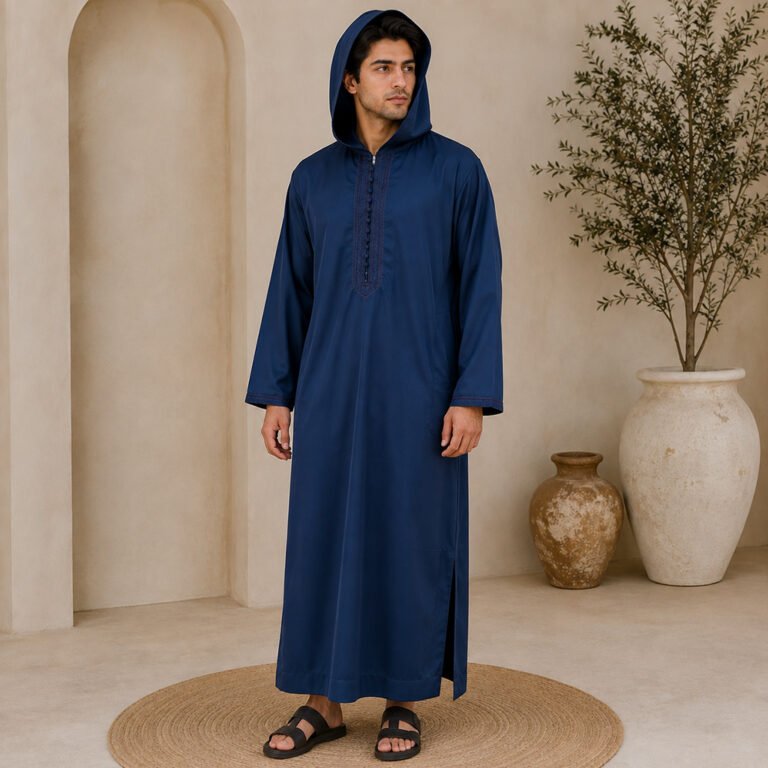
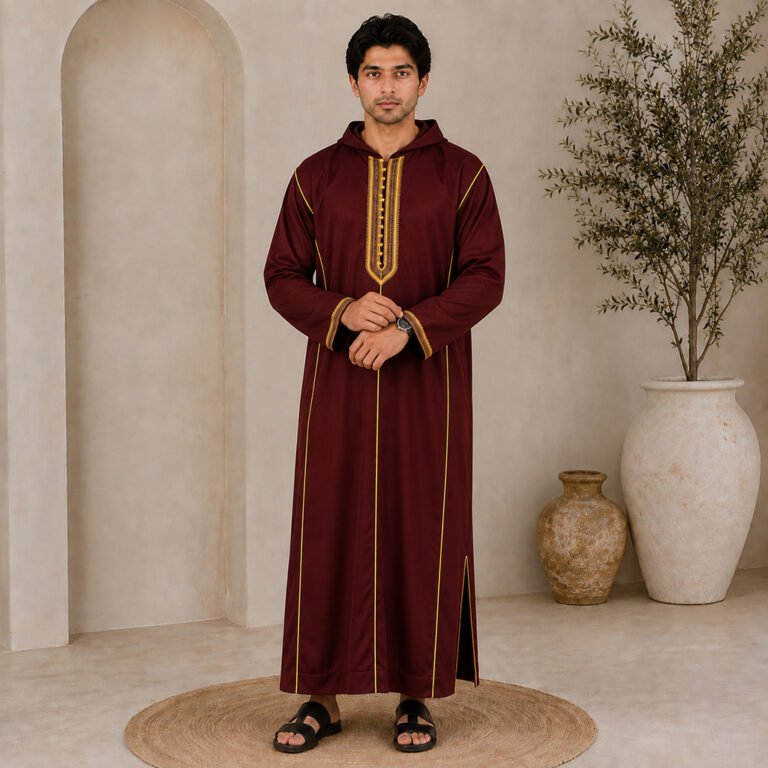
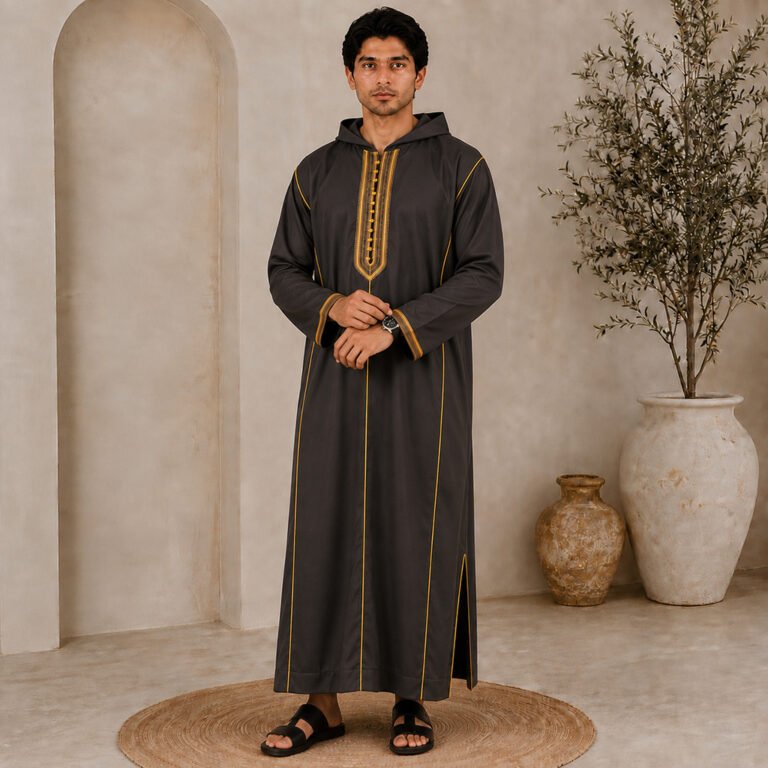
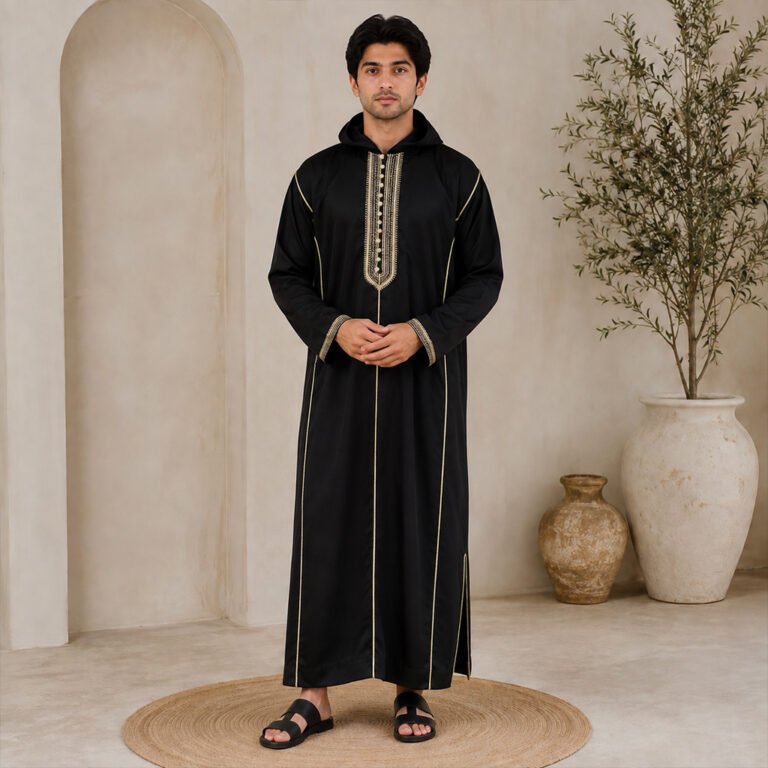
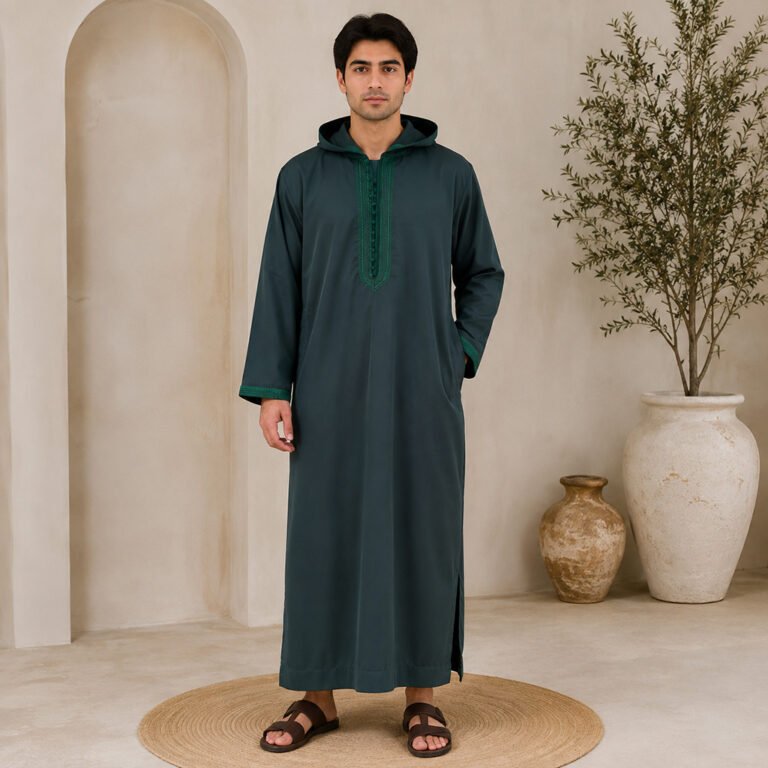
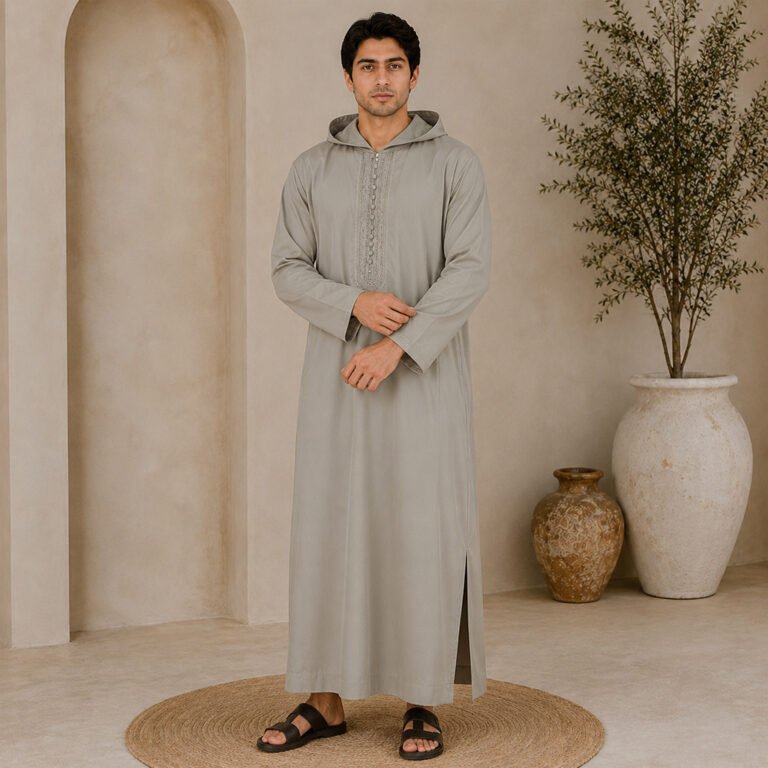
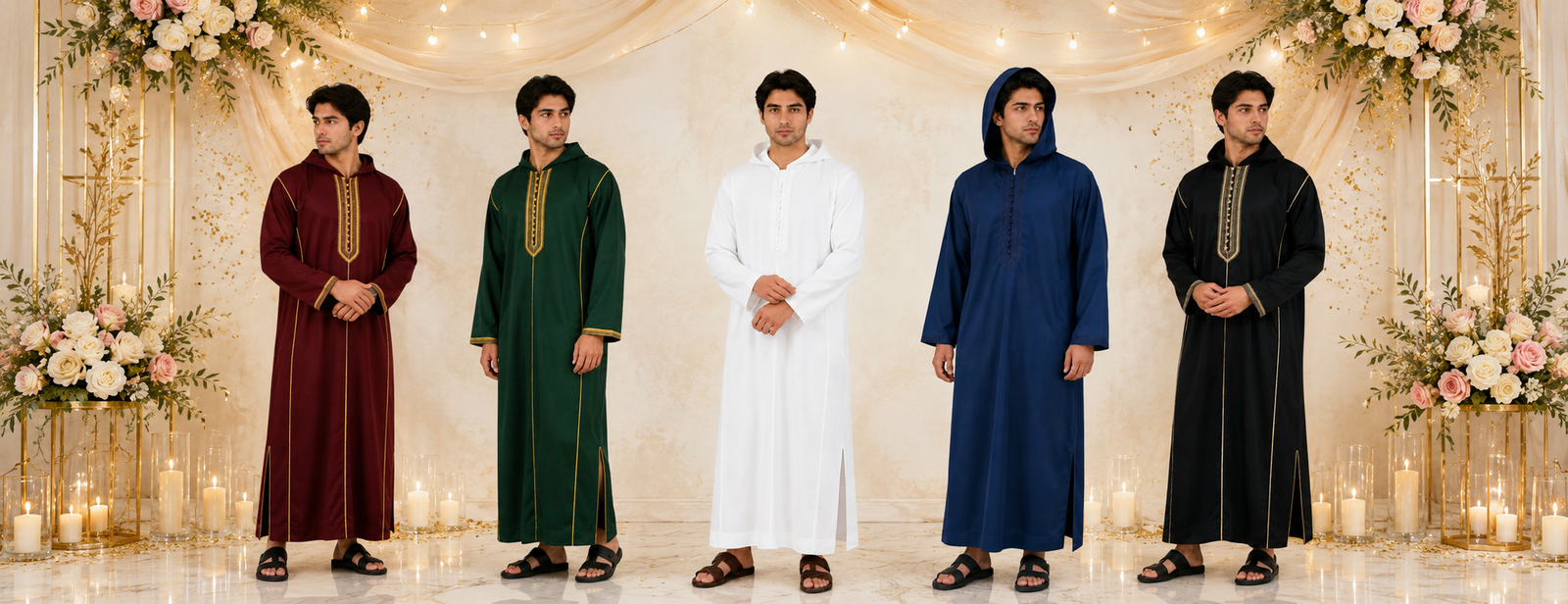
Every djellaba above is £38 and cut to order, S to 8XL. Browse hooded Moroccan djellabas →
What is a Moroccan djellaba?
A djellaba is a full-length, long-sleeved outer robe with a pointed hood. It is cut loose so air can move through it, it covers from neck to ankle, and it is worn by both men and women across Morocco and the wider Maghreb.
The defining feature is the hood. Every other element of the garment varies: fabric, colour, embroidery, how formal it is, how wide the sleeves fall. The hood does not. If it has a pointed hood, it is a djellaba. If it does not, it is something else. That single rule resolves most of the confusion you will find in online listings, where any long Moroccan robe gets labelled a djellaba regardless of whether it has one.
What does the word djellaba mean, and how do you say it?
Djellaba comes from Arabic (جلابة) and is pronounced roughly “jel-lah-bah”. You will see it written several ways in English, all referring to the same garment: djellaba, jellaba, djellabah and jilaba. Moroccan sellers usually write djellaba; British listings often drop the initial d.
Its roots are mixed, which is true of most Moroccan dress. The garment carries Amazigh (Berber), Arab and Andalusian influences layered over centuries, and it was already established in North Africa before Islam spread through the Maghreb. It was absorbed into Muslim dress easily because it already matched the principles of modest clothing: loose, covering, dignified.
What is the qob, and does the hood actually do anything?
The qob is the pointed hood at the back of the djellaba, and it is the reason the garment exists in the shape it does. It was functional from the beginning. A shepherd in the High Atlas, a trader crossing the Sahara, a farmer in the Rif — each needed something they could pull up over the head and face when the sun, wind or sand demanded it.
In practice, and this is the part rarely stated plainly, the qob is worn down far more often than it is worn up. Most of the time it hangs behind the shoulders as part of the silhouette. On a well-made djellaba the edge of the hood is finished with the same braid that runs down the front opening, so it reads as deliberate rather than utilitarian even when it is not in use.
One practical note for prayer: a hood sits behind the neck and shoulders, so a heavy or over-stuffed one can be noticeable in sujood. A well-cut qob lies flat. This is worth checking on any hooded garment you buy, and it is one of the details we watch when cutting ours.
Djellaba vs thobe: which should you buy in the UK?
This is the comparison most guides skip, because they compare the djellaba to the caftan instead. But if you are a Muslim man shopping in Britain, the caftan is not your alternative. The Gulf-style thobe is.
| Moroccan djellaba | Gulf thobe | |
|---|---|---|
| Hood | Yes — the qob, always | No |
| Cut | Wider and looser through the body | Straighter, closer to the frame |
| Sleeves | Wider, often falling open | Narrower, usually cuffed |
| Collar | Usually none — the hood replaces it | Stand collar, or Omani neckline and tassel |
| Reads as | Relaxed, North African, layered | Formal, Gulf, tailored |
| Best in Britain for | Winter, walking to the masjid, everyday | Jummah, work, formal occasions |
Neither is more correct than the other. They come from different regions and they suit different situations, which is why plenty of men own both. If you want the differences between the Gulf cuts as well, our guide on Moroccan versus Emirati thobes covers that, and the different types of jubbas maps the whole family.
Djellaba, caftan, gandoura, jabador: what is the difference?
Moroccan wardrobe terms get used interchangeably online and they should not be. Here is the short version.
| Garment | Hood? | What it is |
|---|---|---|
| Djellaba | Yes | The hooded robe. Runs from plain daily wear to formal. |
| Caftan (kaftan) | No | An ornamented ceremonial robe, today mostly women’s occasionwear. |
| Takchita | No | The two-piece belted form of the caftan. The most formal of all. |
| Gandoura | No | A lighter one-piece tunic, often short-sleeved or sleeveless. Worn at home and in summer. |
| Jabador | No | A men’s two-piece set: tunic over matching trousers. |
| Selham (burnous) | Yes | A hooded cloak worn over other clothes, not instead of them. |
The simplest test remains the hood. A gandoura with a hood sewn on is not a gandoura, and a hoodless robe sold as a djellaba is not one either.
Sfifa, aqad and randa: the craft vocabulary
Three words tell you whether a djellaba has been finished properly, and they are worth knowing before you spend money on one.
- Sfifa — the hand-stitched braid trim that runs along the front opening and around the edge of the hood. On a good djellaba it frames the garment. On a cheap one it is missing or machine-applied and flat.
- Aqad (also written aakad or akaad) — the knotted button-and-loop closures at the collar. Traditionally handmade, and the town of Bhalil in the Fes-Meknes region became known across Morocco for them.
- Randa — openwork embroidery, used more heavily on women’s pieces and sparingly on men’s.
The artisan who leads this work is called a maalem, a master craftsman. In December 2025 UNESCO inscribed “Moroccan Caftan: art, traditions and skills” on its Representative List of Intangible Cultural Heritage. The inscription names the caftan, but the skills it recognises — weaving, tailoring, braid work, handmade buttons, embroidery — are the same ones that finish a fine djellaba.
Men’s djellabas are traditionally more restrained than women’s. Rather than heavy embroidery, they rely on the quality of the cloth and the neatness of the braid. That restraint is exactly why they translate so easily into everyday British wear.
Why does the djellaba suit British weather so well?
Here is the argument nobody makes, and it is the practical reason this garment has found a second home in the UK.
The qob was designed against sun, wind and blowing sand. Britain has almost no sand and not much sun. What it does have is rain on roughly a third of the days in the year, and wind for most of the winter. A hood attached to the garment, rather than to a coat you have to remember, handles both.
Think about the actual journey to Fajr in January, or walking to Jummah in Manchester in November. With a thobe you need a coat over the top, which covers the garment and changes the whole line of it. With a hooded djellaba the protection is built in, and the looser cut leaves room for a layer underneath without pulling anywhere.
The djellaba never became a costume in Morocco precisely because it was useful. That usefulness travels, and in a wetter climate it arguably increases.
Hooded Moroccan djellabas
£38 each, any 3 for £85
Cut to order in our own workshop, S to 8XL. Mix djellabas with thobes in the same bundle — nothing has to match.
What fabric should you choose in the UK?
In Morocco the answer is seasonal: light cotton or linen for summer, wool or flannel for the mountains in winter. In Britain the answer shifts, because you spend more of the year indoors in heated buildings and because the outdoor part of your day is usually short.
| Season | Choose | Why |
|---|---|---|
| Summer | Cotton or linen | Breathes in a crowded hall, which is where you will actually be warm |
| Autumn and spring | Mid-weight blends | The most useful weight in Britain, wearable nine months of the year |
| Winter | Heavier weaves and wool blends | Warmth for the walk, and enough room to layer underneath |
| Eid and occasions | Finished with braid or gold detail | Sfifa and trim lift a plain silhouette without embroidery |
There is more on cloth choices in our guide to what fabric is used for thobes.
How should a Moroccan djellaba fit?
A djellaba is cut wider than a thobe by design, so do not size it the way you would size a Gulf thobe. It should hang from the shoulders without pulling anywhere, with enough room across the chest to sit cross-legged and to wear something underneath in winter.
Three things to get right:
- Length. The hem should sit 1–2 inches above the ankle bone, never dragging on the floor. Length depends on your height, not your chest size.
- Shoulder. The seam should sit at the edge of your shoulder bone. If it slides down the arm the whole robe reads as borrowed.
- The hood itself. It should lie flat when down and actually cover your head when up. Undersized hoods are the most common shortcut on cheap djellabas.
Our Moroccan thobes size chart and measurement guide walk through the numbers. Sizes run S to 8XL, and larger sizes are cut from dedicated plus size patterns rather than scaled up, so the shoulder and hood stay in proportion.
When do men wear a djellaba?
- Everyday. A plain djellaba in a sober colour is genuine daily wear in Morocco, not a costume.
- Jummah and daily salah. The loose cut suits sitting through a khutbah and moving through prayer.
- Eid. The same silhouette in a better cloth, with braid at the front and hood.
- Weddings and nikkah. A finished djellaba in white, off-white or black works, though many grooms choose a structured thobe instead. See wedding thobes if that is the occasion.
- Winter, over layers. The reason the hooded version sells hardest in Britain.
How do you care for a djellaba?
Treat it by fabric, and treat the braid gently. Cotton and blends wash normally at a low temperature, inside out to protect the sfifa along the front and hood. Wool needs a wool cycle or hand washing and should be dried flat rather than hung, because a wet hood pulls the shoulders out of shape.
Our guide on washing thobes in a machine applies to djellabas too, with the one addition that hooded garments should be dried with the hood laid flat.
Our hooded Moroccan djellabas
We cut every djellaba to order in our own workshop rather than buying in finished stock. All are £38 in any size from S to 8XL, and any three thobes or djellabas are £85 instead of £114. They do not have to match, so a winter djellaba, a white thobe for Jummah and something for Eid can go in the same bundle.
- Premium White Moroccan Djellaba — the everyday and Jummah choice
- Deep Emerald Green Hooded Djellaba — colour without embroidery
- Designer Navy Blue Djellaba with Hood — the most forgiving in wet weather
- Elegant Light Grey Djellaba — sober, works nine months of the year
- Maroon & Gold Djellaba — occasion finish with braid detail
- Black & Gold Moroccan Djellaba — for Eid and family gatherings
- Luxury Designer Green Hooded Djellaba — the dressiest green in the range
- Stylish Navy Blue Djellaba with Hood — a cleaner, plainer navy
If you want a hood on a design that is not in the djellaba range, we can add one. See hooded thobes, the wider Moroccan thobes collection, or ask about custom-made if you have something specific in mind.
Delivery across the UK
| Option | Cost | Arrives in |
|---|---|---|
| Free UK delivery | Free | 6–7 working days |
| Urgent delivery | £20 | 3 working days |
Free delivery has no minimum spend and covers the whole United Kingdom. Because each garment is cut after you order it, allow a little time before the date you need it.
Frequently asked questions
What is a Moroccan djellaba?
A long, loose, full-sleeved robe with a pointed hood called a qob, worn by men and women across Morocco for everyday life, prayer and occasions. The hood is the defining feature — without it, the garment is not a djellaba.
What is the hood on a djellaba called?
The qob. It is a pointed hood at the back of the garment, originally used for protection from sun, wind and sand, and worn down as part of the silhouette most of the time.
What is the difference between a djellaba and a thobe?
A djellaba is Moroccan, has a hood, and is cut wider through the body and sleeves. A thobe is Gulf in origin, has no hood, and is cut straighter with a collar or an Omani neckline. Many men own both and wear them for different occasions.
What is the difference between a djellaba and a caftan?
The hood and the occasion. A djellaba has a hood and runs from daily wear to formal. A caftan has no hood and is an ornamented ceremonial robe, today most associated with women’s occasionwear.
How do you pronounce djellaba?
Roughly “jel-lah-bah”. It is also spelled jellaba, djellabah or jilaba in English, all referring to the same garment.
Can non-Moroccans wear a djellaba?
Yes. It is everyday clothing rather than ceremonial dress, and it is worn widely by Maghrebi communities across Europe and by Muslim men generally. Wear it clean and well fitted and it is simply modest menswear.
Is a djellaba suitable for British weather?
Particularly so. The attached hood handles rain and wind without needing a coat over the top, and the loose cut leaves room to layer underneath in winter.
What does sfifa mean on a djellaba?
Sfifa is the hand-stitched braid trim running along the front opening and the edge of the hood. Along with aqad, the knotted button loops at the collar, it is the main sign that a djellaba has been properly finished.
How much does a Moroccan djellaba cost in the UK?
At Men Thobes UK every hooded Moroccan djellaba is £38 in sizes S to 8XL, and any three thobes or djellabas together are £85 instead of £114.
Made to order, S to 8XL
Pick your djellaba
£38 each, or any three for £85. Free UK delivery in 6–7 working days, urgent £20 in 3.
More on Moroccan and hooded thobes
- Hooded Moroccan djellabas — the full collection
- Moroccan thobes — the wider range
- Hooded thobes — hoods on other cuts
- Moroccan vs Emirati thobes
- Different types of jubbas
- Customised Moroccan hooded thobes
- Premium hooded thobes and stitching detail
- Plus size tailored-fit hooded thobes
- Islamic garments for men — a guide
[…] What is a Moroccan djellaba? — the qob, the craft terms, and how it is made […]