
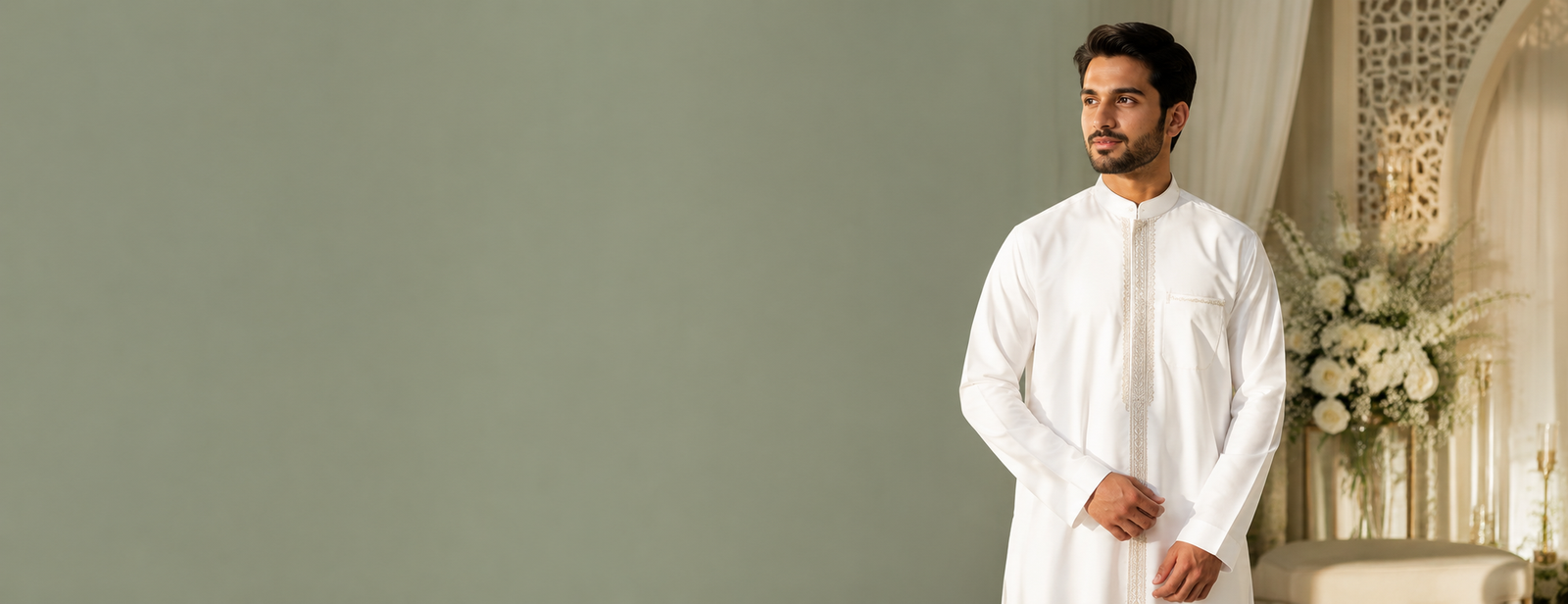

Men should wear modest, formal clothing covering the shoulders to the ankles. At a masjid nikah, traditional dress — a thobe, kurta or sherwani — is the safest choice. At a hotel or banqueting hall, traditional dress or a well-cut suit both work. Grooms usually wear white, ivory or black; guests wear a solid colour without heavy embroidery.
The rest of this guide covers the details that decide between those options: venue, your role, the season, and the fit points most men get wrong
What is a nikah ceremony?
The nikah is the Islamic marriage contract — the point at which the couple are married. It is usually short, often 20 to 40 minutes, and is frequently held separately from the walima (the celebration meal), sometimes on a different day.
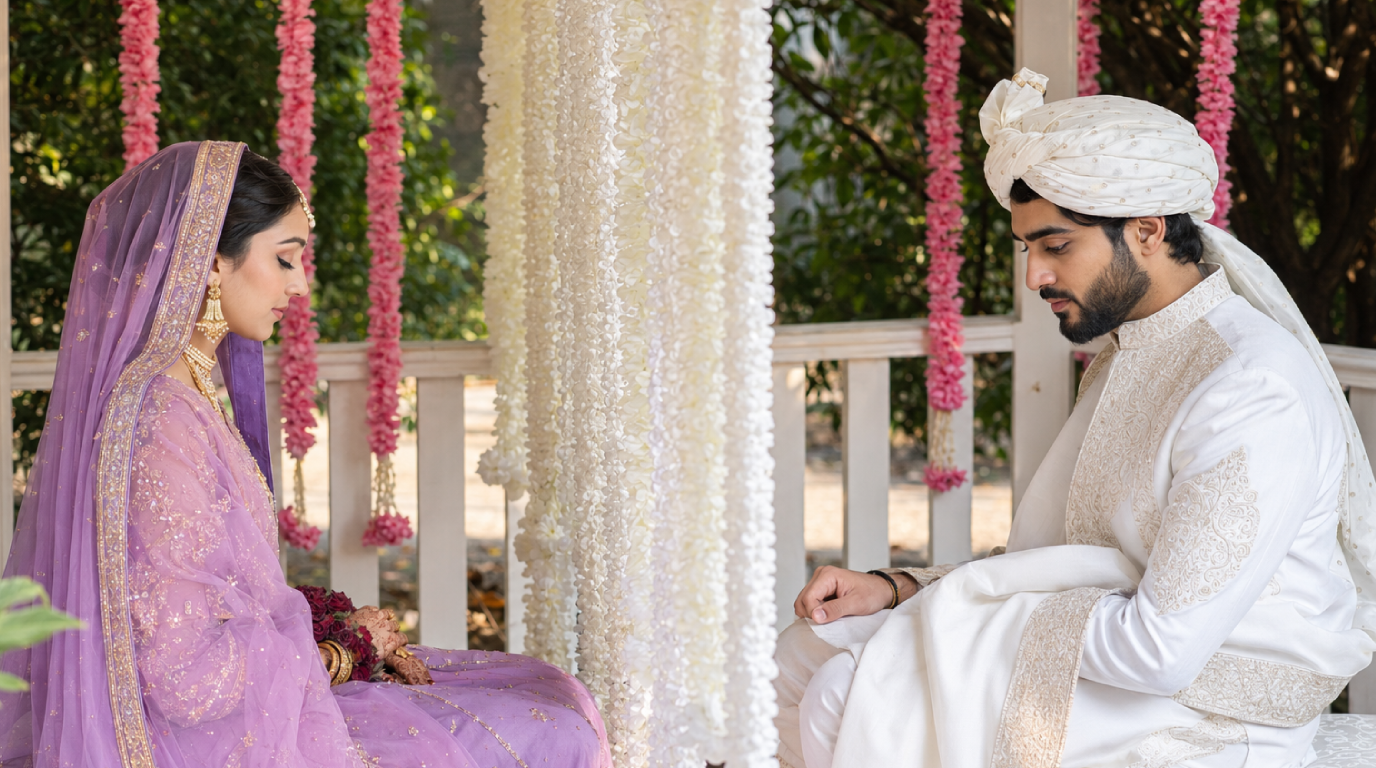
In the UK, nikahs are most commonly held in a masjid, a community or banqueting hall, a hotel, or at home. Where it’s held affects the dress code more than the invite ever will.
“Ready to order your wedding thobe?”
BOOK CONSULTATIONDoes the venue change what you wear?
Yes — more than anything else on this page.
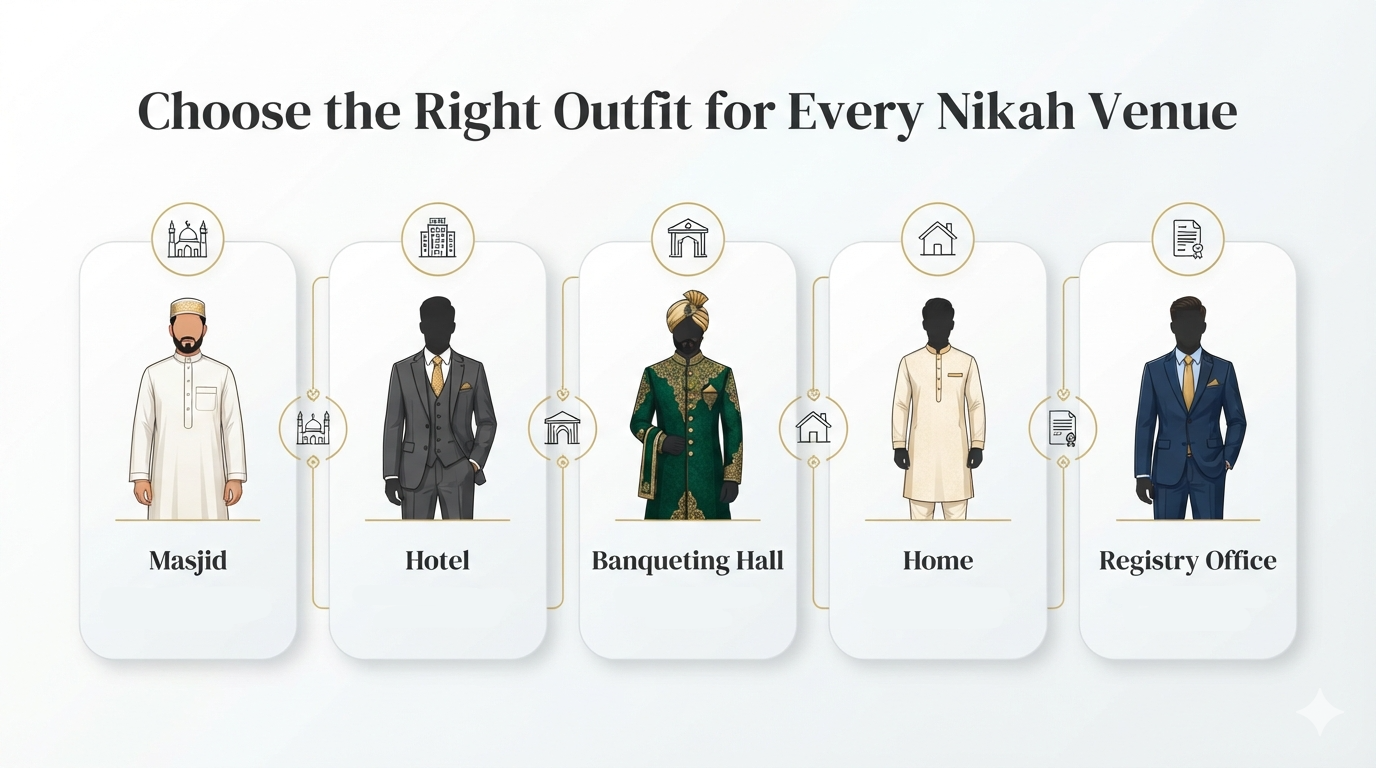
Masjid nikah. The most common in Britain and the most understated. Traditional dress dominates: thobes, kurtas, sherwanis, kufis. A suit isn’t wrong, but you’ll be the one man taking off dress shoes and sitting on the floor in suit trousers.
Hall, hotel or banqueting suite. Higher formality across the board. Dress up rather than down. Full wedding thobes, sherwanis and sharp suits all belong here.
Home nikah. Small and family-only. Smart traditional dress is right; a full wedding sherwani in a living room is too much.
Registry office plus a separate nikah. Two events, sometimes two days. The registry office leans Western-formal, the nikah leans traditional. Don’t wear the same outfit to both if photographs matter to you.
If you don’t know which you’re attending, ask the person who invited you. One message beats an afternoon of feeling wrong.
What should the groom wear to his nikah?
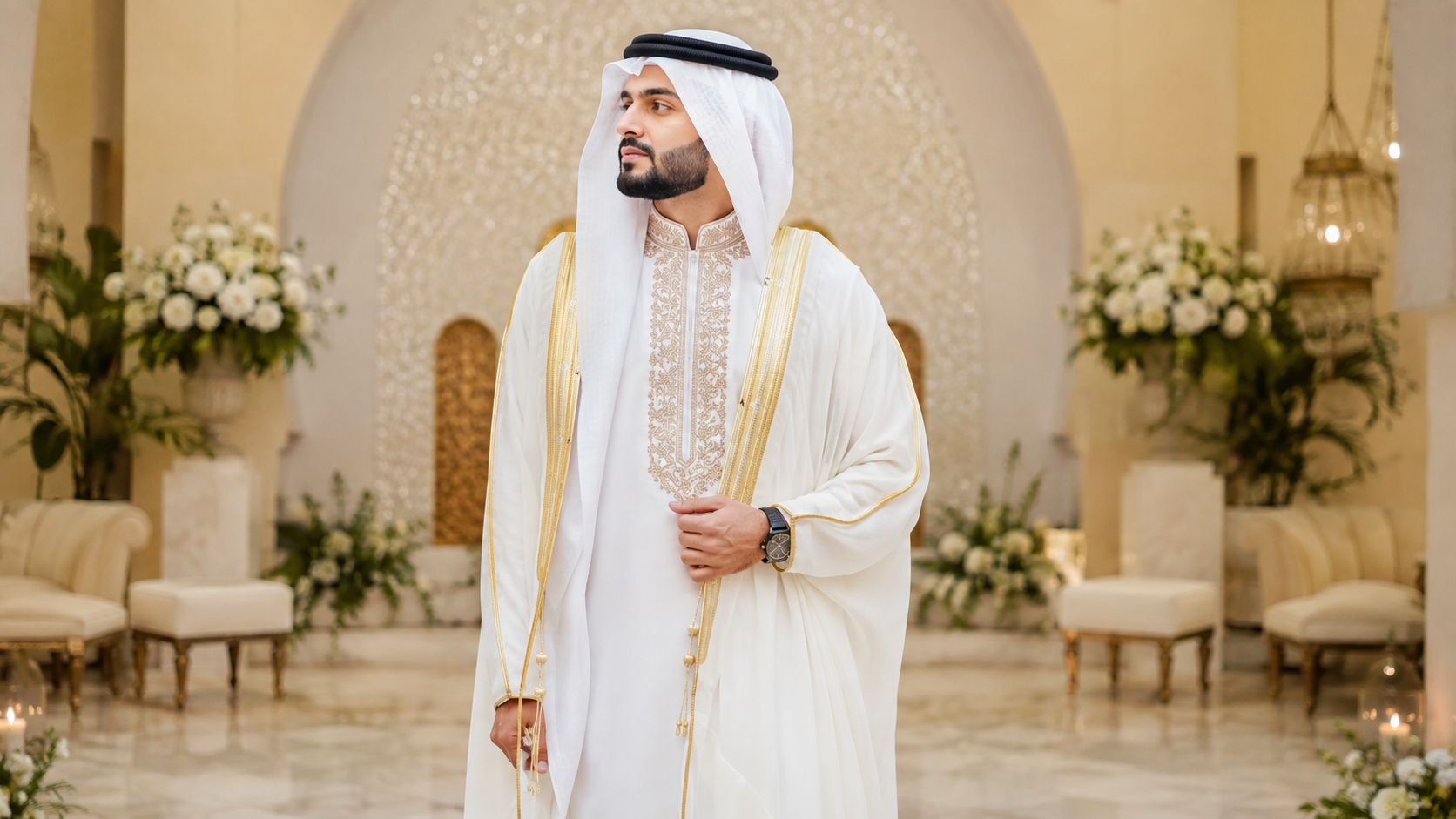
The groom should be visibly distinguishable from his guests — not louder, just identifiable in the photographs.
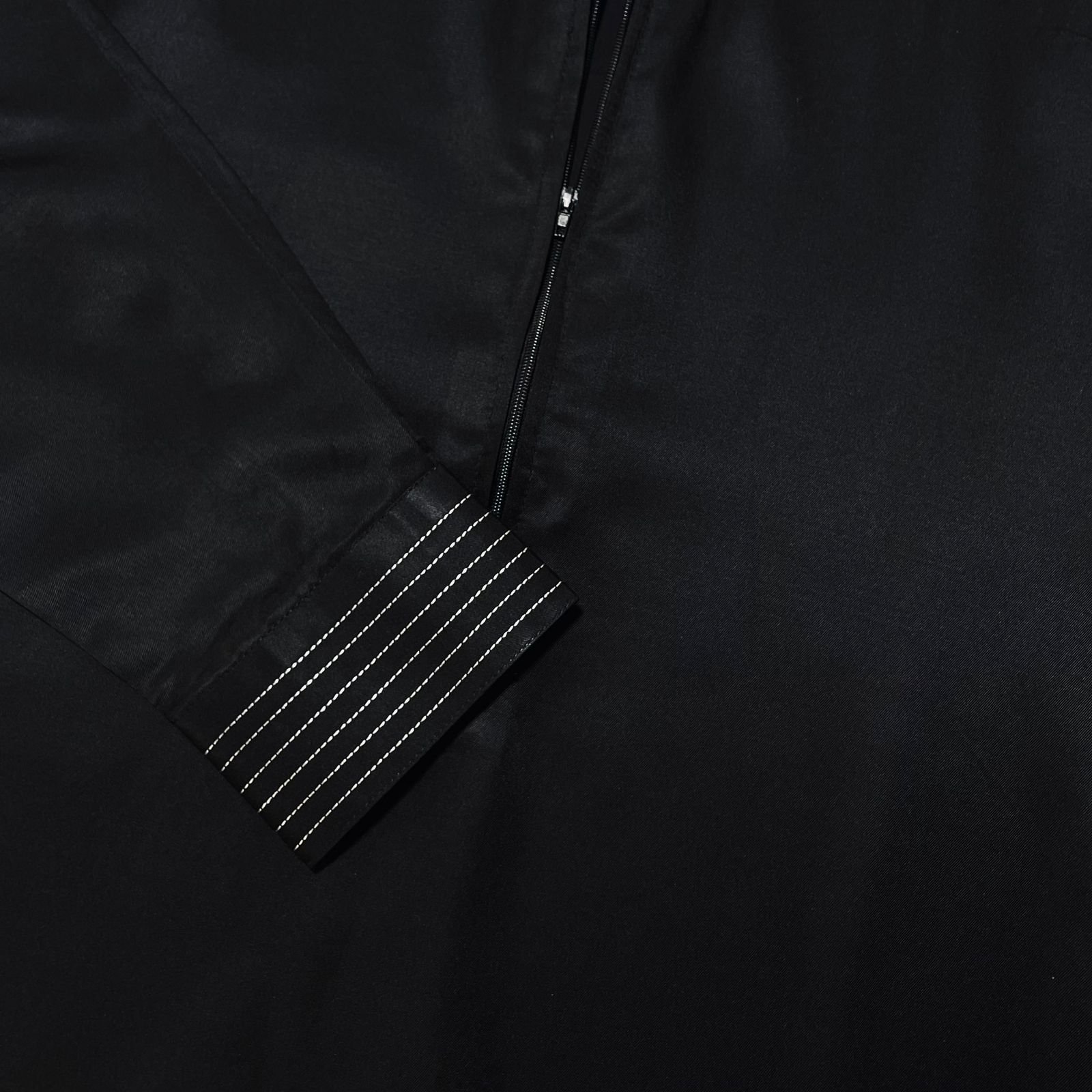
Traditionally that means white, ivory or cream, usually with embroidery, contrast piping or a collar detail. Among UK South Asian grooms it increasingly means black, deep maroon, bottle green or beige with gold work. Both are correct.
A wedding thobe, a sherwani, or a formal suit all work. Arab grooms often add a bisht over the thobe.
“Ready to order your wedding thobe?”
BOOK CONSULTATIONWhat should guests wear to a nikah?
Look like you made an effort, and don’t out-dress the groom.
In practice: a solid-colour thobe, a well-cut kurta, or a good suit. Avoid heavy gold embroidery, avoid a bisht, and avoid full white if the groom is likely to be in white.
If you’re the groom’s father, brother or closest friend, you’re in the photographs and greeting people at the door — dress a level above a normal guest, a level below the groom.
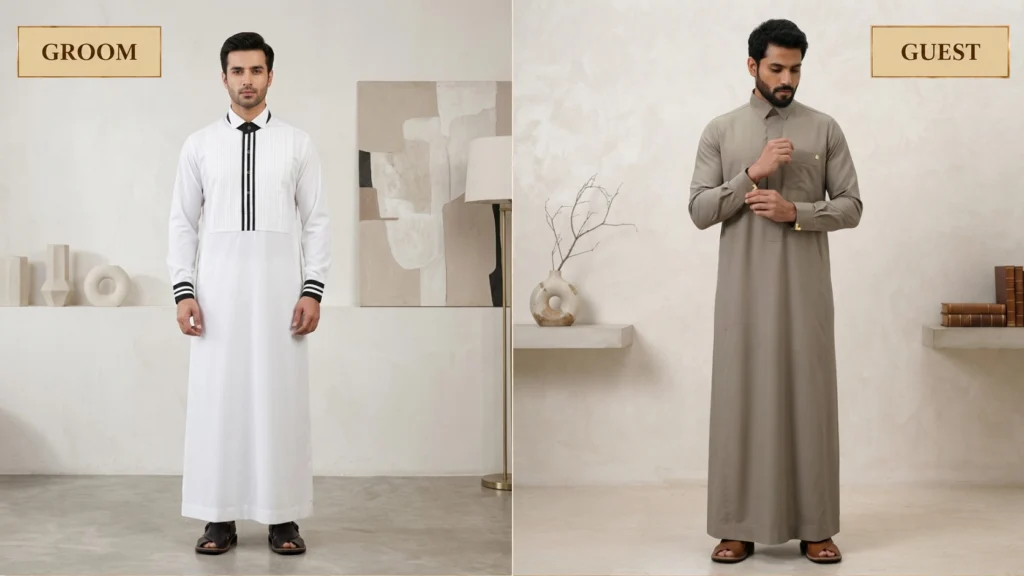
Should you wear a thobe, sherwani, kurta or suit?
All four are acceptable. They differ in where they work best.
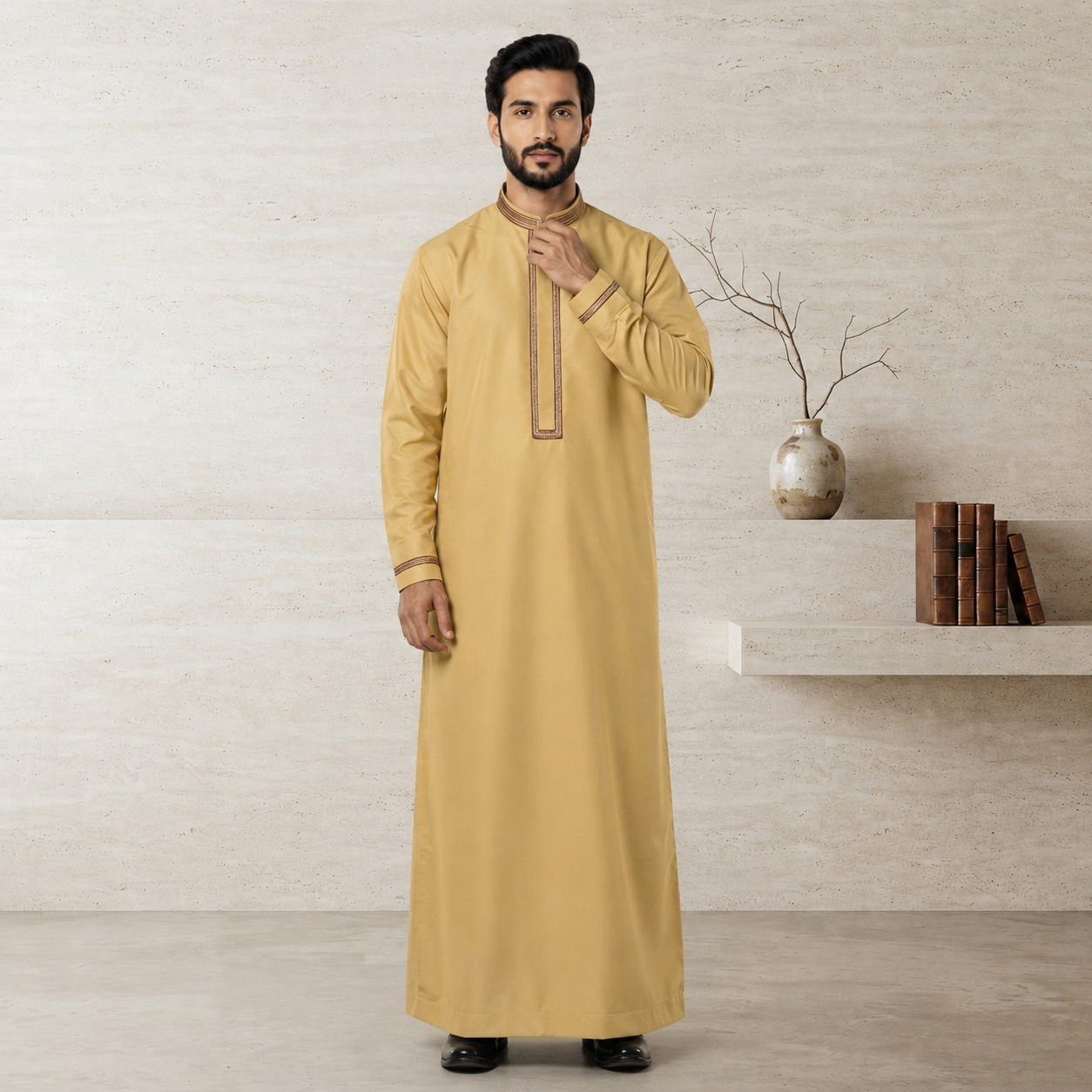

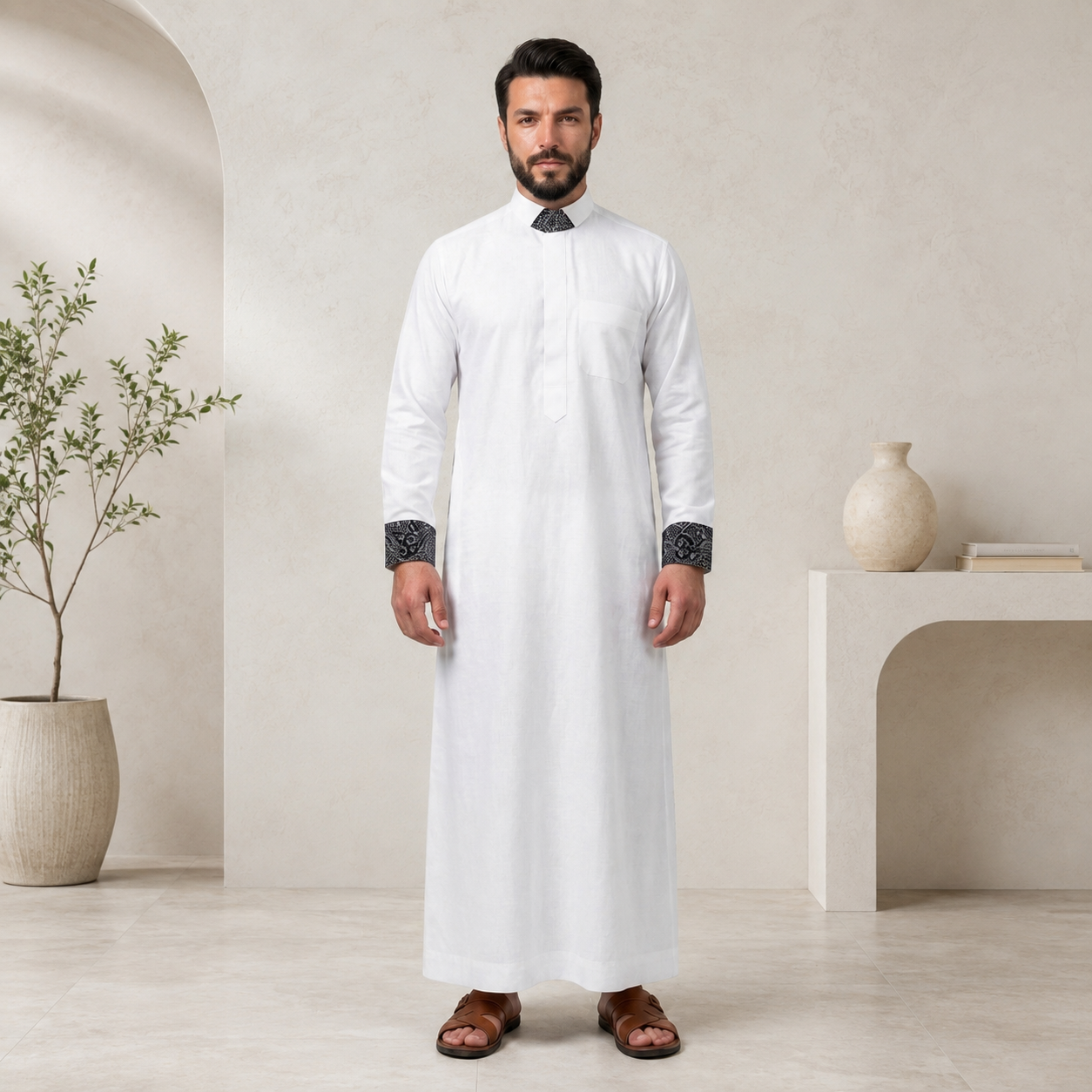
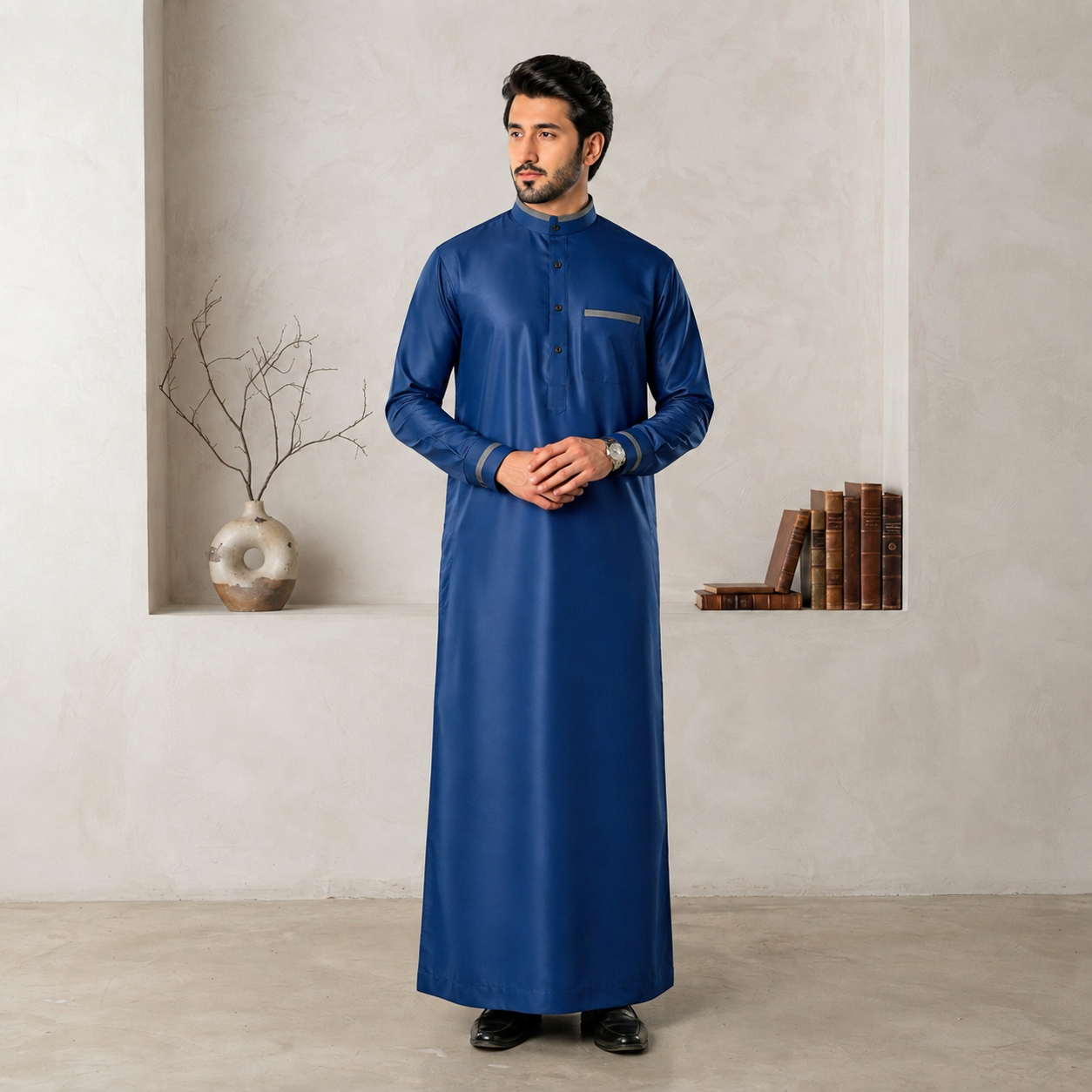
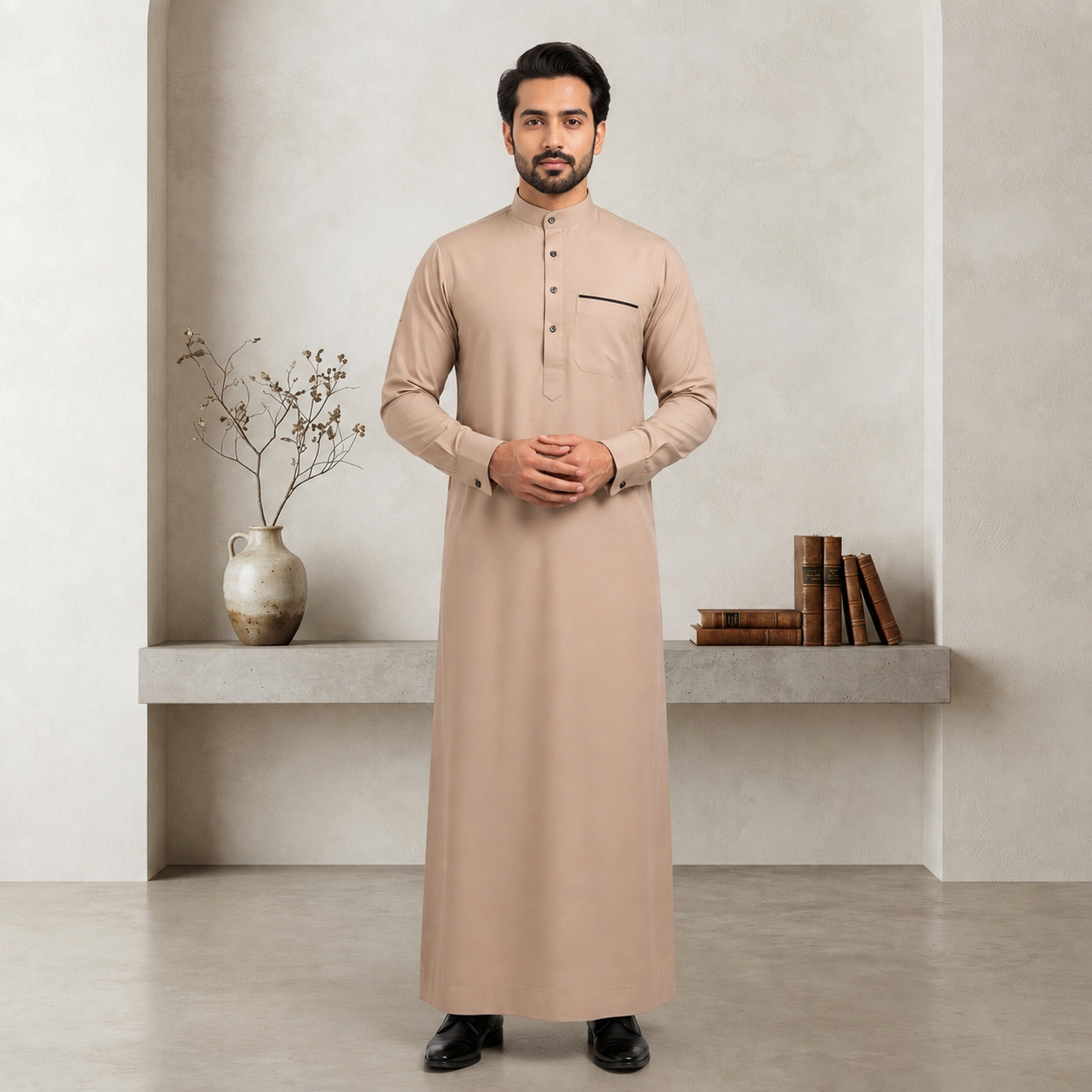
Thobe (jubba) — works at every venue type, comfortable seated on the floor, no tie needed, and easy to coordinate across a family. Fit is everything; a badly sized thobe looks like a tent.
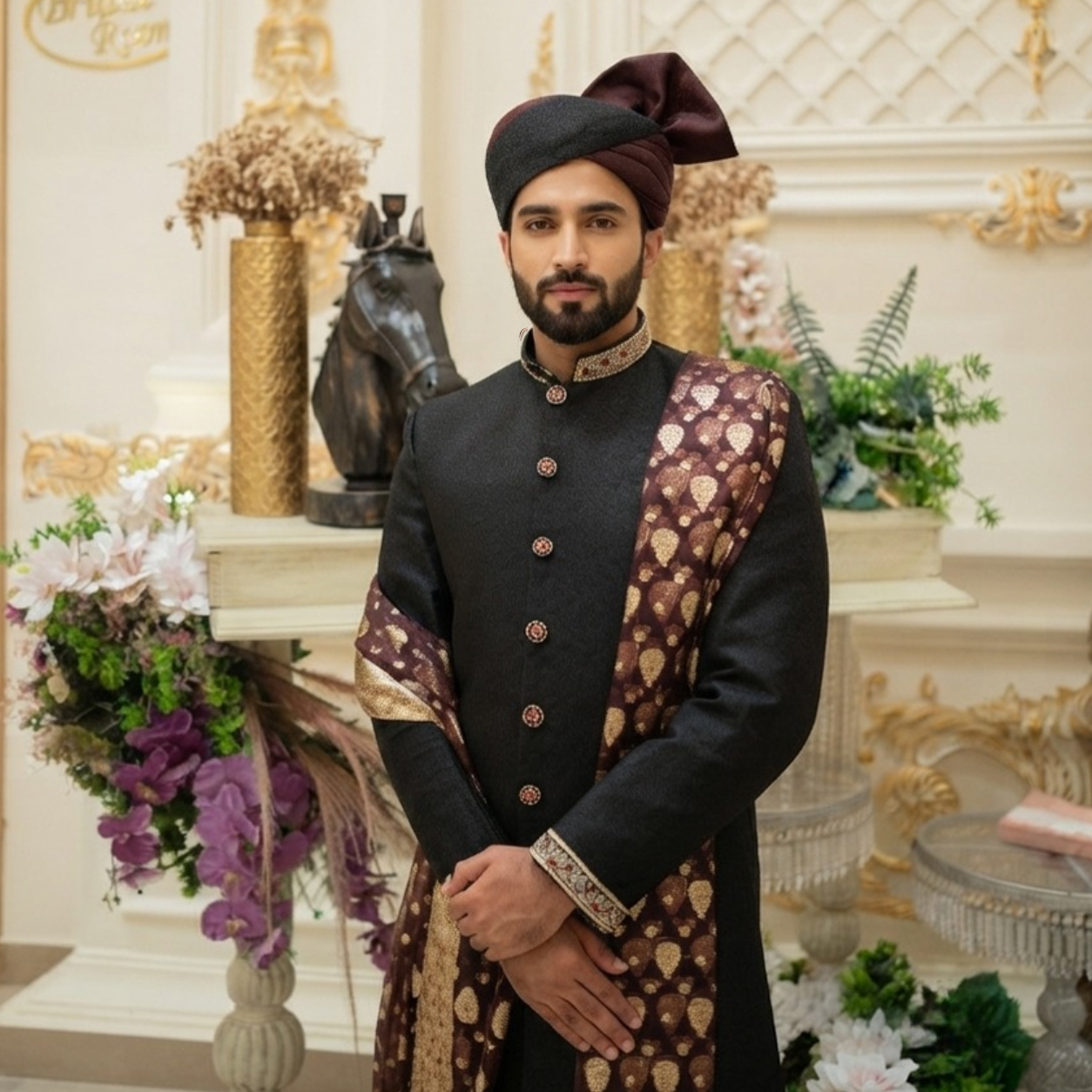
Sherwani — the traditional South Asian groom’s choice, excellent in a hall or hotel. Heavy, hot, expensive, and overkill for a short masjid nikah.
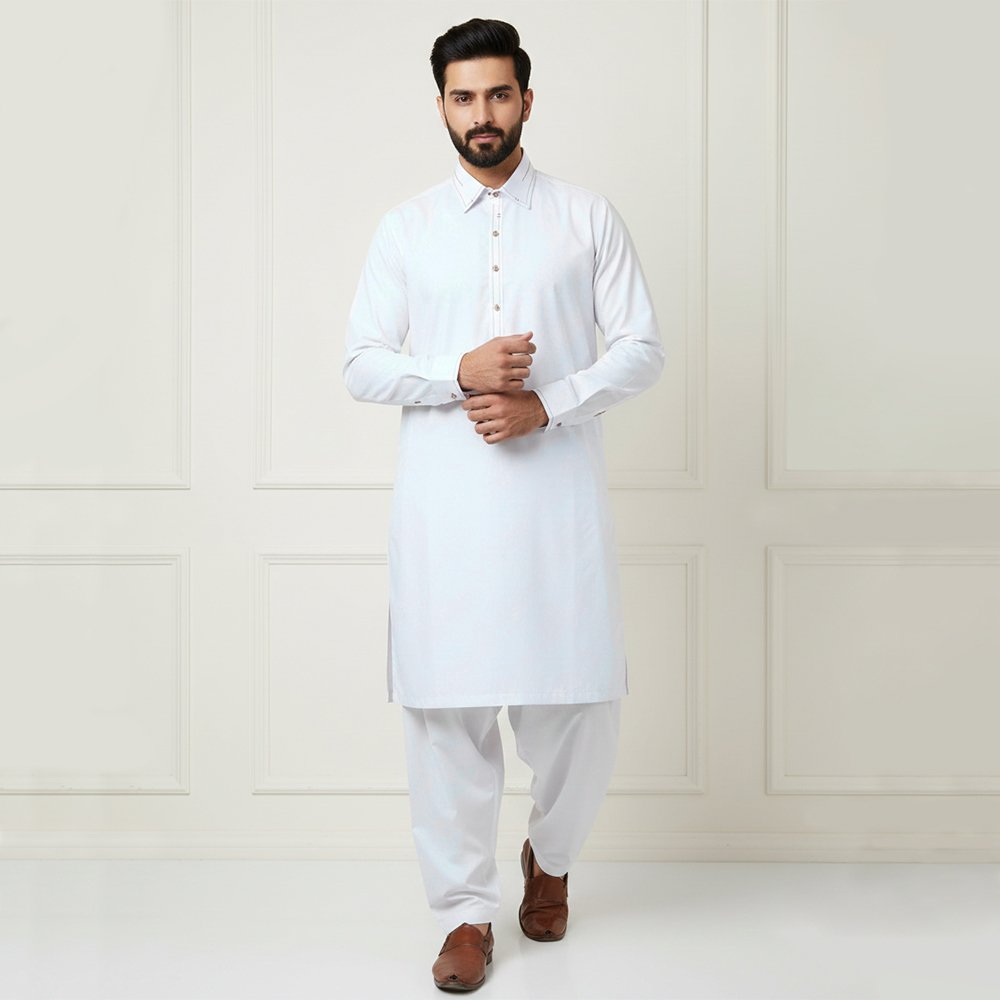
Kurta pyjama or shalwar kameez — a solid guest option and the right call for a home nikah or warm weather. Reads casual unless the fabric and fit are good.
Suit — never wrong. Best at a registry office, hotel, or mixed-culture wedding. Worst at a shoes-off, floor-seated ceremony or a packed hall in August.
The thobe is the option that fails least often. It’s appropriate at every venue above, it’s comfortable through a long ceremony, it works from a summer garden nikah to a February masjid with a coat over it, and it’s the simplest garment to match across eight men in a wedding party.
What should guests wear to a nikah?
All four are acceptable. They differ in where they work best.
Thobe (jubba) — works at every venue type, comfortable seated on the floor, no tie needed, and easy to coordinate across a family. Fit is everything; a badly sized thobe looks like a tent.
Sherwani — the traditional South Asian groom’s choice, excellent in a hall or hotel. Heavy, hot, expensive, and overkill for a short masjid nikah.
Kurta pyjama or shalwar kameez — a solid guest option and the right call for a home nikah or warm weather. Reads casual unless the fabric and fit are good.
Suit — never wrong. Best at a registry office, hotel, or mixed-culture wedding. Worst at a shoes-off, floor-seated ceremony or a packed hall in August.
The thobe is the option that fails least often. It’s appropriate at every venue above, it’s comfortable through a long ceremony, it works from a summer garden nikah to a February masjid with a coat over it, and it’s the simplest garment to match across eight men in a wedding party.
What colour should you wear to a nikah?
- White, ivory, cream — traditional groom’s colours, the most photographed. Guests should avoid full white if the groom is wearing it.
- Black — the most common modern choice for UK grooms. Photographs sharply, but can look flat in low light; black with gold or ivory detailing works better.
- Beige, stone, taupe — the safest guest colours. Formal, warm, and they compete with nobody.
- Maroon, bottle green, navy — where coordinated wedding parties usually land. All three sit well against the gold-and-cream décor most UK banqueting halls use.
- Grey — underrated for guests, slightly cold for grooms.
Worth asking in advance: what palette has the bride’s side chosen? Turning up in bright royal blue when the party is in dusty rose shows up in every group photo.
How should a thobe fit?
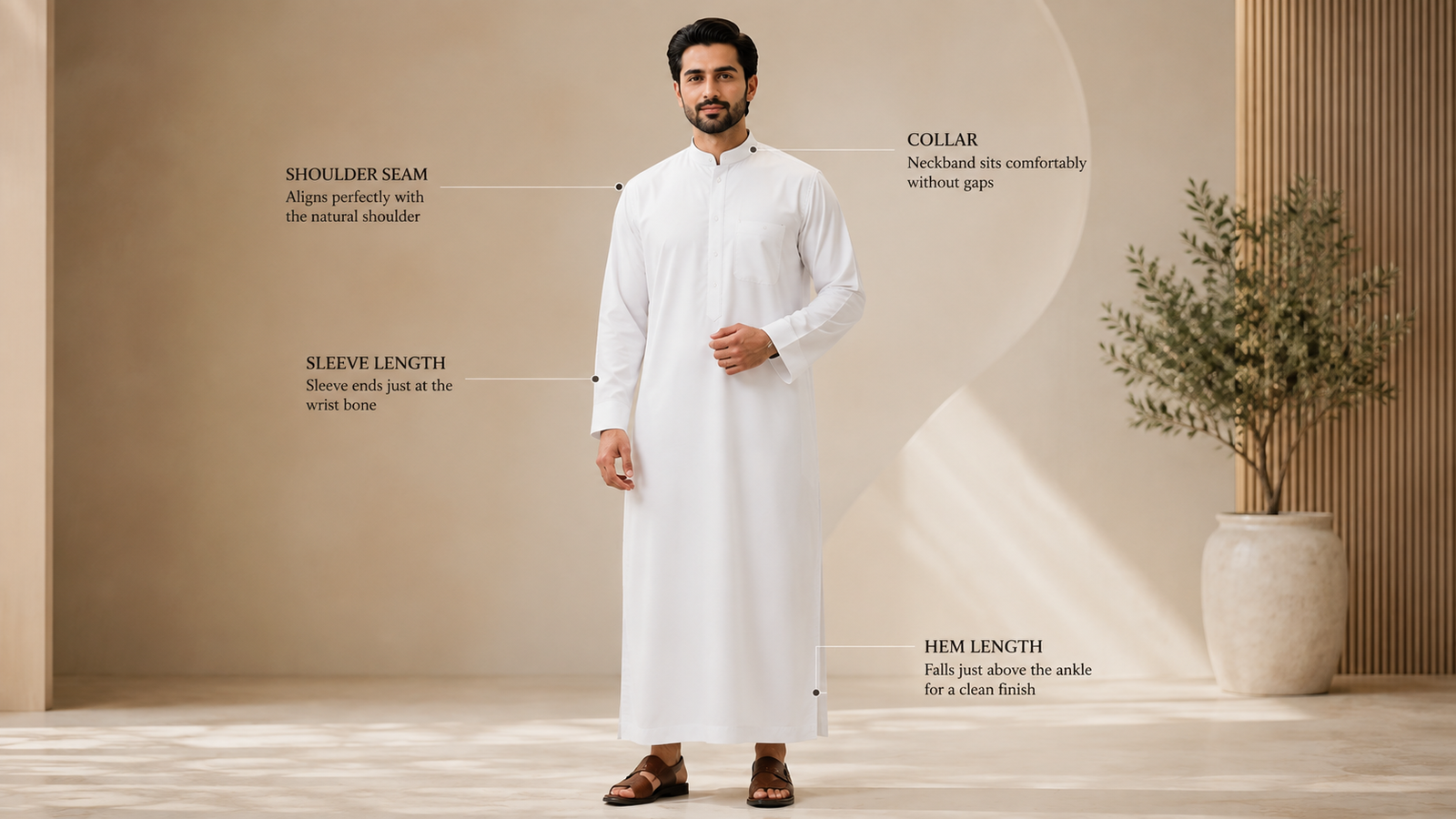
Four things do most of the work.
Hem — should sit at or just above the ankle bone. Not on the floor, not at mid-calf.
Sleeve — the cuff should end at the wrist bone, so the hand is clear and a watch just shows.
Shoulder seam — should sit on the edge of the shoulder, not partway down the upper arm. If this is wrong, nothing else rescues the garment.
Collar — a collar or mandarin neckline reads more formal and suits grooms. A plain round neck is cleaner and suits guests.
On hem length specifically: there’s a practical reason and a religious one. Practically, a dragging hem gets filthy in a UK car park. Religiously, the widely held scholarly position is that men shouldn’t let their garment fall below the ankles, based on well-known narrations on the subject. Schools differ on how strongly that applies — some treat it as prohibited only when done out of arrogance — but almost nobody argues for a floor-length hem.
If you’re between standard sizes, that’s the strongest argument for having it made to your own measurements. Our wedding thobes are cut to measure rather than pulled off a rack, and our plus size range runs to 8XL rather than telling bigger men to size up and hope.
No tailor’s appointment is needed — the sizing guide on our custom made thobes page walks you through measuring at home in about five minutes.
Which fabric is best for a UK nikah?
It depends on the season.
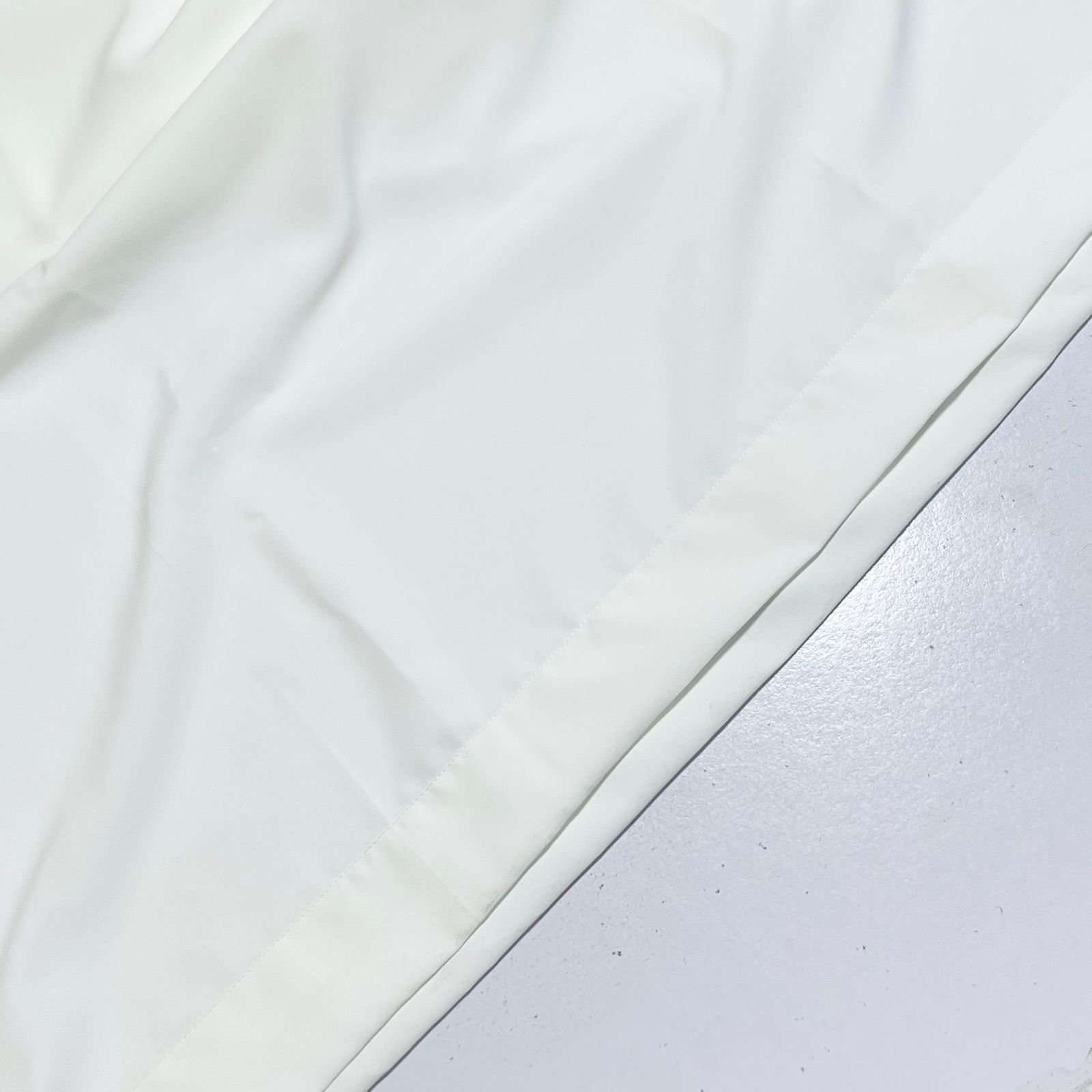
Spring and summer — polyester or Toyobo. Both are lightweight, breathable and wrinkle-resistant, which matters after an hour in the car. Polyester carries a subtle sheen; Toyobo has a structured fall with far less shine.
Autumn and winter — cashmere wool. Warmer than standard wool without the bulk, with a drape that photographs well in low indoor light. Less breathable, so it’s a cold-months fabric rather than an all-rounder.
Cotton — comfortable and breathable, but it creases. Better for a home nikah than a full wedding day.
One warning for photographs: high-shine fabric under masjid LED lighting and a photographer’s flash can blow out and lose all the detail you paid for. Subtle sheen photographs beautifully; cheap high-gloss polyester does not.
What shoes and accessories work?
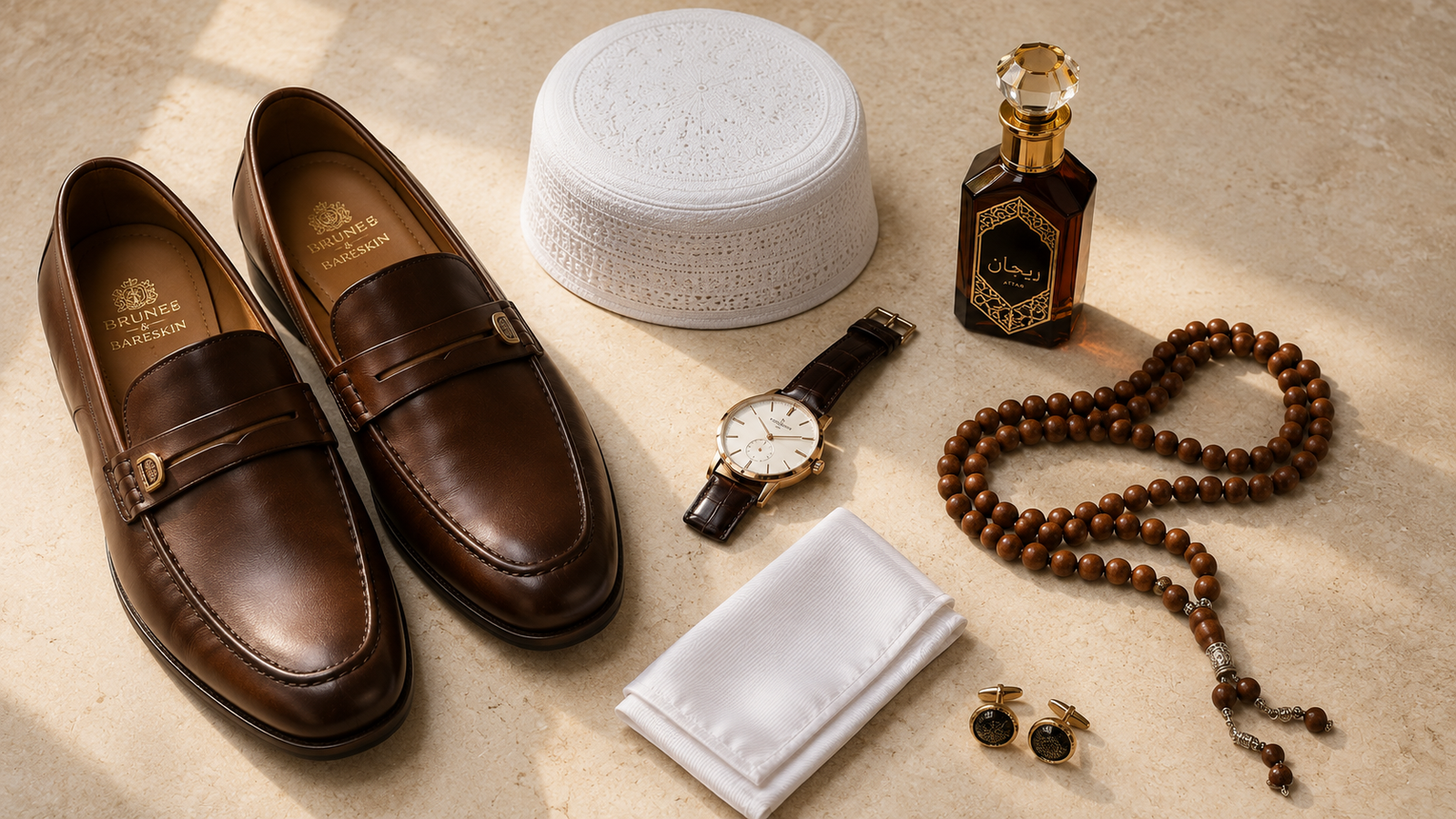
Keep it to two or three pieces. More than that and it becomes costume.
- Shoes — leather loafers, brogues, khussa or dressy sandals, in black or tan, clean. Never trainers. Slip-ons are the practical choice at a masjid.
- Socks — genuinely part of the outfit, because your shoes are coming off. No holes, no white sports socks.
- Kufi or topi — appropriate for everyone and never looks like it’s trying too hard.
- Shemagh, ghutra or keffiyeh — striking with a thobe and standard at Arab weddings. If it isn’t part of your family’s tradition, it can read as dressing up rather than dressing well.
- Watch — the most effective accessory with a thobe, because your wrists are visible all day.
- Misbaha and a light attar — traditional and understated.
What should you not wear to a nikah?
- Jeans, tracksuits, trainers, hoodies or shorts — even at a casual masjid nikah.
- Anything sheer enough to see through, which is a real risk with cheap white fabric under bright lighting.
- Pure natural silk and gold jewellery. On the majority scholarly position, both are impermissible for Muslim men and permitted for women. Silk-blend, artificial silk and silk-look polyester aren’t affected, so ask what a fabric actually is before buying. Silver and steel are fine.
- A bisht, if you’re a guest. It’s the groom’s garment.
- Visible logos and branding.
- Anything you’ve never worn before. Try it on a week early, sit down in it, walk up stairs in it.
What do most men forget about a UK nikah?
Your shoes are coming off. At any masjid nikah and plenty of home and hall ones. Slip-ons save you kneeling in a crowded shoe rack while forty men queue behind you.
You may be sitting on the floor. Cross-legged, for half an hour, often with no back support. This is where suit trousers punish you and a thobe quietly wins.
It’s Britain. Masjid prayer halls in January are cold, car park photos happen in drizzle, and hall heating is either off or tropical. Season should drive your fabric before style does.
How do you coordinate the wedding party?
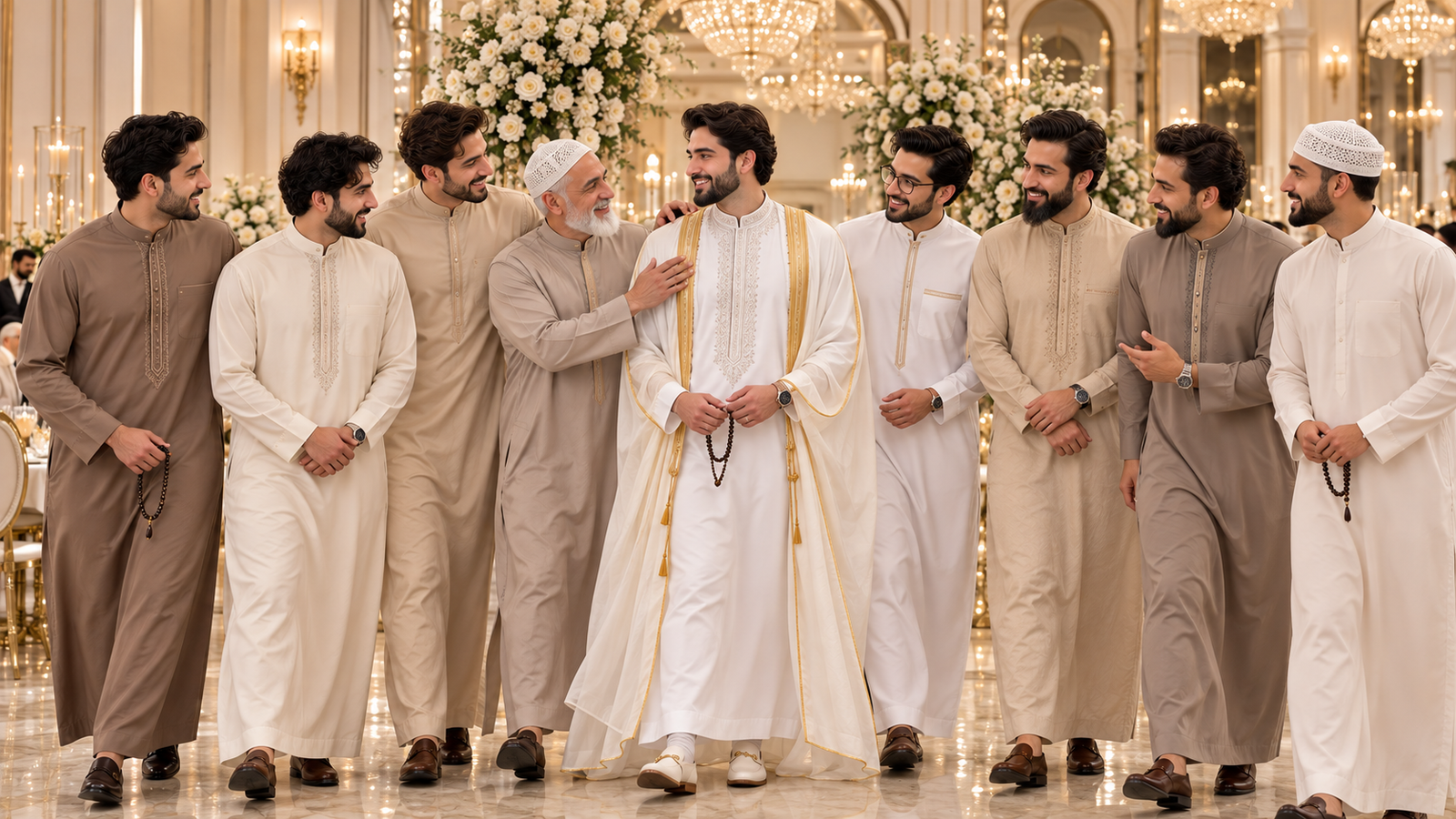
Put the men in one colour or one design — father, groom, brothers, groomsmen. It photographs superbly and removes several group-chat arguments.
The practical problem is stock. Most thobe retailers sell from a warehouse, so a nine-man order in one colour runs out mid-size, and someone ends up in a near-enough shade that shows in every photo.
Because we manufacture in-house, a coordinated order is cut and stitched as one batch, from one roll of fabric, with each man measured separately. Per-thobe pricing improves with group size, and it’s one order and one delivery. Details are on the wedding thobes page.
How far in advance should you order?
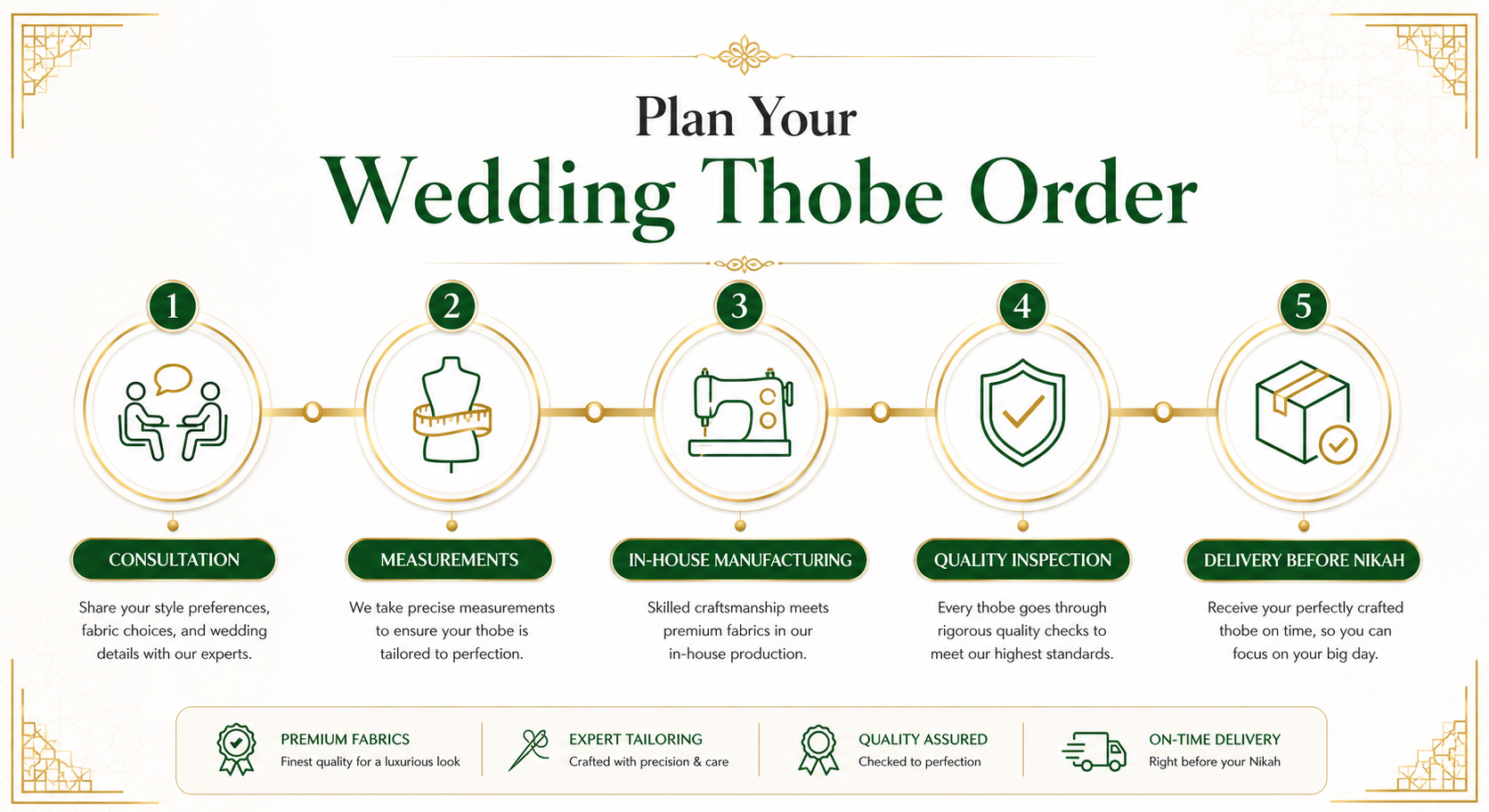
- Guests buying off the rack — two to three weeks, leaving room to exchange a size.
- Made-to-measure for the groom — six to eight weeks. Four at a push.
- Coordinated family orders — eight weeks or more. Collecting nine sets of measurements takes longer than making nine thobes.
- Peak season — the run-up to Eid and the summer wedding months are busiest. Book earlier.
FAQ's
What should a man wear to a nikah in the UK? Modest, formal clothing covering shoulders to ankles. Traditional dress — a thobe, kurta or sherwani — for a masjid nikah; traditional dress or a well-cut suit for a hotel or hall.
Can I wear a suit to a nikah ceremony? Yes. It isn’t wrong anywhere. It’s just less at home in a masjid, where most of the room will be in traditional dress and you’ll be sitting cross-legged in suit trousers.
What colour should the groom wear to his nikah? White, ivory and cream are traditional. Black, deep maroon and bottle green are common modern choices in the UK. What matters is being distinguishable from the guests.
Can guests wear a thobe to a nikah? Yes, and it’s a good choice. Keep it a solid colour without heavy embroidery so you’re not competing with the groom.
What’s the best fabric for a nikah in the UK? Polyester or Toyobo for spring and summer — lightweight, breathable, wrinkle-resistant. Cashmere wool for autumn and winter, where warmth and drape matter more.
How long should a thobe be? At or just above the ankle bone. Below the ankle is impractical and, on the widely held scholarly position, best avoided for men.
Can men wear silk or gold to a nikah? Pure natural silk and gold are, on the majority position, impermissible for Muslim men. Silk-blend and artificial-silk fabrics aren’t affected, and silver and steel are fine.
How far in advance should I order a wedding thobe? Six to eight weeks for a made-to-measure groom’s thobe, longer for a coordinated family order.
Getting married? Every wedding thobe we make is cut and stitched in-house to your measurements, in the fabric, colour and design you choose — XL to 8XL included, free UK delivery, and family-pack pricing for the whole wedding party.